
Is IPTV legal? Yes—the technology is legal. Internet Protocol Television simply describes television delivered through IP networks. A licensed broadcaster, telephone company, or streaming platform can use it lawfully. Trouble starts when a seller retransmits channels, films, or live sport without permission, or when a viewer knowingly uses access designed to avoid the right holder’s payment or territory controls. I checked current government, court, and copyright-office sources on October 8, 2026.
The name, app, payment receipt, channel list, or working stream does not settle the question. Legality depends on who controls the content, which rights the service holds, where those rights apply, and what the customer does with the stream. This guide offers a practical screening process for ordinary viewers. It is general information, not legal advice for a particular country, dispute, or enforcement notice.
Is IPTV Legal? The Short Answer
IPTV is lawful when the service has permission to distribute the content to the viewer in the relevant territory and follows the applicable broadcasting, copyright, consumer, and contract rules. I separate the delivery method from the content source because the same smart TV, set-top box, playlist format, or player can be used for authorized television or unauthorized retransmission.
A familiar example is a broadband company delivering subscribed channels through its managed network. A broadcaster’s own live-TV app is another. By contrast, a seller offering nearly every premium channel and new film for a tiny fee may be retransmitting material it does not control. The important question is not “Does this use IPTV?” but “Who authorized this service to carry these programmes here?” Rights can also be limited by country, platform, event, language feed, or subscription tier. A legitimate service in one market does not automatically have the same catalogue rights everywhere.
What Makes an IPTV Service Legal or Illegal?
The decisive issue is authorization. A service generally needs an appropriate licence, ownership interest, statutory permission, or another valid legal basis to transmit protected programmes. I would also check whether the offer respects territory and account limits, because permission to show a channel in one country or on one platform may not cover worldwide resale through a different app.
Unauthorized services often capture or obtain legitimate feeds, repackage them, and sell access without the relevant rights. Payment does not cure that problem. Neither does a professional website, a company registration, a privacy policy, or an app-store listing. Those details may help identify the seller, but they do not prove programme rights. The U.S. Copyright Office describes an illicit digital transmission service around unauthorized public performance for commercial advantage or private financial gain, while UK guidance distinguishes lawful media devices from devices or add-ons configured to access paid material unlawfully.
Legal IPTV vs Illegal IPTV: Practical Differences
No single sign proves legality, so this is a screening tool rather than a verdict. In my review of official guidance, the strongest positive signal is a verifiable relationship between the service and its content. Several weak signals together justify more questions before payment.
| Check | More consistent with an authorized service | Warning sign that needs investigation |
|---|---|---|
| Service identity | Verifiable company, support route, terms, and billing entity | Anonymous seller using disposable chat accounts or changing domains |
| Content rights | Explains territories, packages, blackouts, and channel availability | Claims every premium channel, film, and event worldwide with no rights explanation |
| Price and billing | Price resembles the documented package and billing period | Extremely low lifetime access or crypto-only payment with no workable remedy |
| Apps and devices | Uses official stores or documented installation routes | Requires security settings to be weakened or an unknown package to be sideloaded |
| Availability | Catalogue changes by location and rights | Promises that geo-blocks, takedowns, and blackouts never apply |
| Customer terms | States renewal, cancellation, refund, and stream limits | No legal entity, no stable terms, and no meaningful refund process |
Eurojust’s illegal-IPTV guidance also warns that unlicensed services can expose users to malware and loss of personal data. A low price is not proof of infringement, and a high price is not proof of authorization. Check the rights trail, not the polish of the sales page.
How to Check Whether an IPTV Service Is Legal
Start with the channel or programme you actually want, then work backwards. I use this sequence because broad claims such as “licensed content” are less useful than evidence tied to a named service, territory, and package.
- Identify the seller’s legal name, country, billing entity, support address, and current terms.
- Check the broadcaster, league, studio, or channel owner’s official viewing page for approved services in your country.
- Compare the exact package, territory, device, and event. Rights for highlights, replays, and live coverage can differ.
- Ask the seller who authorizes the channel distribution. Treat slogans, channel logos, and screenshots as marketing, not proof.
- Review payment, renewal, refund, privacy, and simultaneous-stream terms before entering card details.
- Avoid instructions that require bypassing access controls, using stolen credentials, or disabling device protection.
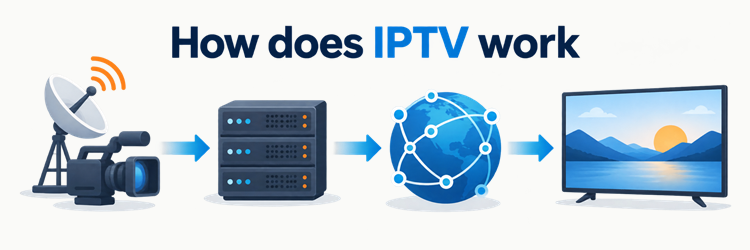
The IPTV technology explainer can help separate a player, playlist, and delivery network from the underlying television rights. If the seller cannot provide a credible answer, use the right holder’s own service or another clearly authorized distributor.
How IPTV Law Differs by Country
Copyright principles cross borders, but offences, exceptions, and remedies differ. I treat these examples as orientation. A court or local lawyer must apply current law to specific facts.
| Jurisdiction | Useful official reference | Practical point for viewers |
|---|---|---|
| United States | Copyright Act, DMCA, and 18 U.S.C. § 2319C | Unauthorized commercial streaming services and circumvention can trigger separate rules; do not assume a paid subscription is licensed |
| United Kingdom | Copyright, Designs and Patents Act guidance | Dishonestly receiving a programme to avoid a charge and commercial dealing in unauthorized decoders are specifically addressed |
| European Union | CJEU case C-527/15 and national copyright laws | The Court held that temporary copies from a knowingly unlawful streaming source did not qualify for the cited exception; national enforcement still varies |
| Canada | Copyright Act notice-and-notice system and CRTC guidance | CRTC licensing does not determine copyright legality; Canadian programme rights still matter |
| Australia | Copyright Act 1968 and online-infringement framework | The statute separates reception, copying, communication, and commercial conduct; rights holders can seek blocking orders against qualifying overseas locations |
The CJEU’s Filmspeler judgment, Canadian consumer guidance, and Australian legislation show why one universal viewer-liability claim would mislead. Location and conduct matter.
Are IPTV Apps and Players Legal?
An IPTV player is usually a general-purpose tool: it can display a lawful stream, an unauthorized stream, or no content at all. I do not treat M3U support, Xtream-style login fields, an electronic programme guide, or app-store availability as evidence that a particular subscription has distribution rights. The service and the source loaded into the player must be assessed separately.
The same principle applies to common streaming hardware. A legal device does not become illegal merely because it can run media software. Risk changes when a box is sold, promoted, or modified specifically to provide unauthorized access. UK government guidance states that media streaming boxes are legal until adapted with apps or add-ons for unlawful access to paid material. The app licence also does not include channels unless the developer clearly supplies an authorized service. For device and service distinctions, the rights-first provider checklist explains why branding and channel counts are not licensing proof.
Can a VPN Make IPTV Legal?
No. A VPN changes the network path and visible IP address; it does not create copyright permission, a sports right, a broadcast licence, or an account entitlement. I would use privacy and security tools only within the law and the service’s terms, never as a substitute for authorization.
Geo-blocking commonly reflects territorial licensing. The CRTC’s consumer explanation notes that a service may block a programme when it lacks rights for the viewer’s region. Circumventing that control can breach contract terms and may engage additional law depending on the jurisdiction and method. A VPN can also make a legitimate service appear to be used from an unsupported country, causing login or payment problems. The VPN and IPTV guide covers privacy uses and limitations without treating location masking as permission to unlock content.
What Can Happen If You Use Illegal IPTV?
Consequences vary widely. A provider may disappear after a domain seizure, payment account closure, or rights-holder action, leaving customers without service or refunds. I found official European guidance that also warns about malicious software, stolen payment details, exposure of personal information, and links between illegal IPTV revenue and organized crime.
Legal exposure depends on local law and what the person did. Operating, reselling, restreaming, supplying unauthorized devices, sharing credentials, or circumventing protection can be treated differently from passive viewing. Some systems allow copyright notices, civil claims, blocking orders, equipment seizure, fines, or criminal prosecution in defined circumstances. Do not rely on claims that “only sellers are targeted” or that “viewers can never be liable.” If an ISP, court, right holder, or payment provider sends a notice, preserve it, avoid admissions or payments demanded through suspicious links, and obtain advice from a qualified lawyer or consumer authority in that jurisdiction.
What to Do If You Already Paid for a Questionable Service
Stop before adding more money, devices, or personal information. I would first disable auto-renewal through the payment method, save the receipt and seller communications, and remove any unknown app that required unusual permissions. Do not continue using the service merely to “get value” from the payment.
Run the device’s trusted security scan, change reused passwords from a clean device, and monitor the payment account for unfamiliar charges. Contact the card issuer or payment provider through its official channel if the seller misrepresented the service or keeps billing; describe the facts accurately rather than claiming a charge was unauthorized when it was initially approved. Report suspected fraud or illegal distribution to the relevant consumer, police, copyright, or cybercrime authority. If a formal infringement notice arrives, use the official contact details and seek local legal advice. Do not pay a settlement demand embedded in an unverified email without confirming its authenticity.
Final Answer
Is IPTV legal? The technology is legal, but a particular service is lawful only when it has the rights and permissions required for the content, territory, platform, and customer use. I would verify the seller’s identity, confirm the exact channels through right-holder sources, read the account terms, and avoid any offer built around bypassing payment or access controls. A paid plan, familiar app, or polished website is not licensing proof. When the rights trail is unclear, choose the broadcaster’s own service or a clearly authorized distributor and seek local legal advice for a specific concern.
FAQs
Is free IPTV legal?
Free IPTV can be legal when a broadcaster, public service, or rights holder offers it with authorization. I would check the official source and territory rather than judging by price. Free access to premium channels from an unrelated seller is a warning sign, not proof of permission.
Is paid IPTV always legal?
No. Payment proves only that money changed hands. I look for a verifiable seller and evidence that the service may distribute the named content in the viewer’s country. Unauthorized operators can charge subscriptions, issue receipts, and run professional-looking websites.
Can I get in trouble for watching illegal IPTV?
Possibly, depending on the country, the viewer’s knowledge, and the conduct involved. I would not assume immunity for customers. Restreaming, reselling, bypassing protection, or knowingly using an unlawful source can create different risks from ordinary reception, so local advice matters.
Does an IPTV player include legal channels?
Usually not. A player commonly supplies playback and guide features but no television rights. I check the separate subscription or source loaded into it. Buying the app does not authorize a playlist, and a working login does not prove the streams are licensed.
How can I report an illegal IPTV service?
Use the official reporting channel for the relevant country, such as a police cybercrime unit, consumer-protection agency, copyright office, or affected broadcaster. I would preserve receipts, URLs, and messages without downloading or redistributing the streams, then avoid further contact through suspicious links.